
Emergency Garage Door Repair Near Me: What Westwood Homeowners Should Do First
The 15 minutes after a garage door fails decide whether you’re looking at a spring repair or a much bigger bill. Trying to force a door with a broken spring is the most common way a $300 spring job turns into a $900 track and cable replacement, and it happens because nobody told the homeowner what “leave it alone” actually means. This is that instruction. Read it before you touch anything, and if you’d rather not deal with it at all, call (855) 337-1660. We answer 24/7.
Key Takeaways
- A door with a broken spring or a snapped cable stays put. Do not force it up or down.
- The pull cord on the opener is for a dead opener, not a broken spring. Using it on a spring failure can send the door crashing down.
- You can secure an open garage opening without tools in about a minute.
- A quick visual check at the cable drum tells you whether you have one repair or two.
- Keep people and pets out of the space directly above and beside the door until a technician arrives.
What Should You Do in the First 15 Minutes After a Door Fails?
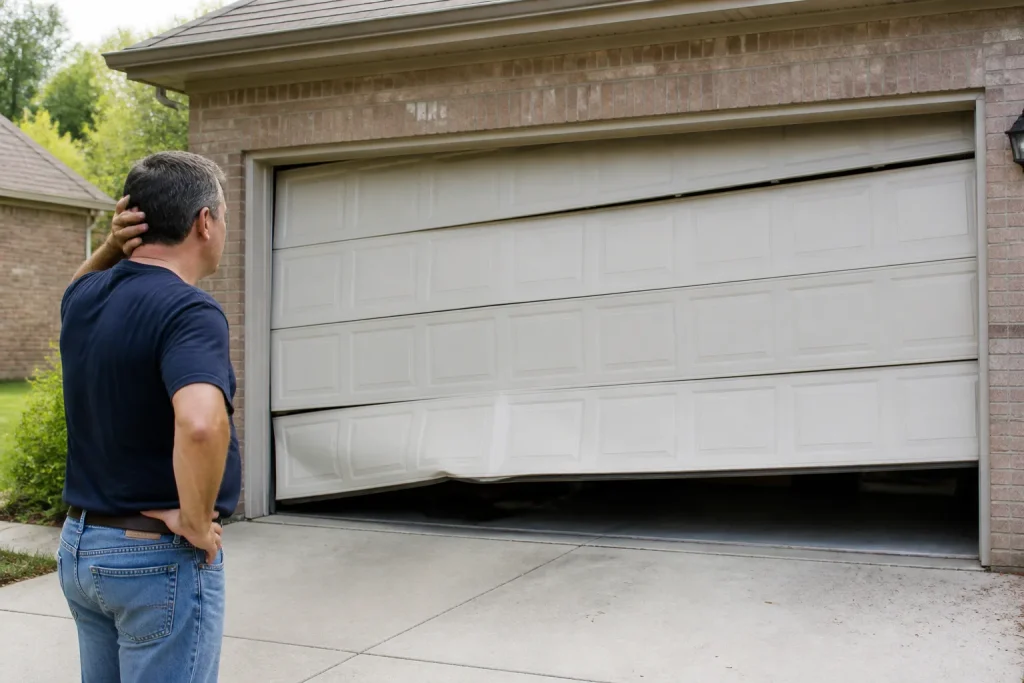
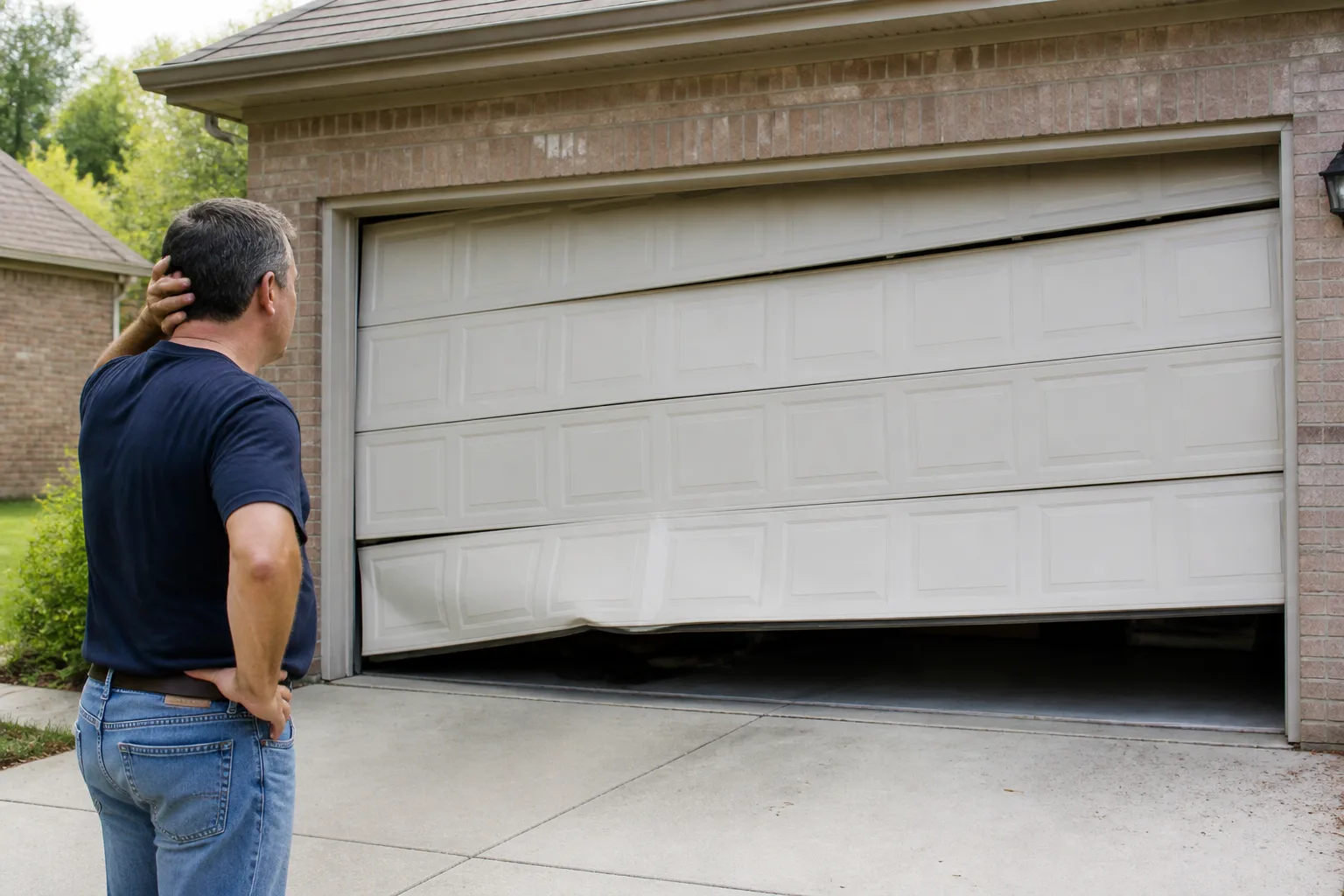
Stop the door where it is, get everyone clear of it, and leave the springs and cables alone. Then figure out two things: is the door stuck open or stuck closed, and did you hear a bang. Your answers to those two questions decide what happens next, and they’re the first things we ask when you call.
Here’s the order that works. It takes about 15 minutes and none of it involves a wrench.
- Clear the area. Move the car if it’s not under the door, pull kids and pets back, and get anything breakable out from under the door path.
- Stop pressing the button. Cycling a broken opener keeps forcing a damaged door. If the door is halfway and the opener is straining, unplug the opener unit if you can reach the plug safely, or shut off the circuit at the panel if the outlet is behind the door.
- Look, don’t touch. Stand back and look at the springs above the door and the cables running down each side. You’re looking for a visible gap in a torsion spring or a cable hanging slack. Both mean the door is no longer supported.
- Decide open or closed. A door stuck closed is inconvenient. A door stuck open is a security question, and that’s the next section.
- Call and describe it plainly. “The door is halfway up and I heard a bang” tells us more than “the garage is broken.” That sentence alone points a technician toward a spring or cable failure before anyone leaves the shop.
One note on the opener itself. Many Westwood homes have a LiftMaster or Chamberlain unit with a battery backup, and those will keep trying to run the door after the power is cut. If yours does, pull the battery cover off and you’ll usually find the door stops trying.
How Do You Use the Manual Release Cord Safely?
Only pull the manual release cord when the opener has failed and the springs are still intact. If you heard a bang, see a broken spring, or see a slack cable, do not pull the cord. The cord disconnects the door from the opener, and on a door with a failed spring the opener’s gearing is the only thing holding the door up. Pull it then, and the door comes down hard.
When the opener is the problem and the springs look fine, this is the sequence:
- Close the door first if you can. A released door is easier to control close to the floor.
- Stand to the side of the door, not under it. Reach for the cord and pull straight down and slightly toward you.
- Lift slowly with both hands. A properly balanced door should lift with one hand and stay where you put it. If it feels heavy, or it wants to fall, stop and let it back down. That’s a spring or balance problem, not a release problem.
- Re-engage the trolley carefully. When you’re done, run the opener until the carriage meets the trolley and it clicks back in. Don’t force it.
That “should lift with one hand” test is genuinely useful. A door that fights you on the way up is telling you something is wrong with the springs or the balance, and it’s better to hear that from the door than from a bent panel.
How Do You Temporarily Secure a Stuck-Open Garage Door?
Three methods work without tools, and none of them interferes with the repair. Pick based on what you have on hand and how long the door will be open.
- Close it manually, if the door will move. On a door stuck open because of an opener failure, release the trolley and walk the door down, then leave it down. This is the cleanest option and the one we’d choose first.
- Block the opening from inside with a vehicle. Park a car with its bumper close to the inside of the opening. It won’t stop a determined intruder, but it removes the easy walk-in.
- Prop and pad the door. If the door is jammed partway and won’t come down, wedge something solid under the bottom section to take the weight off a strained panel, and avoid slamming it. Then leave it. Don’t try to muscle a jammed door down; that’s how panels kink and tracks bend.
What we’d steer you away from: tying the door down with rope, screwing blocks into the track, or anything that changes the door’s hardware. Those “fixes” tend to add a track repair to the original problem, and they make the eventual repair take longer. If the door is stuck open on a Westwood home in a windy stretch of the year, closing it manually is worth the two minutes.
How Can You Tell If a Broken Spring Also Damaged the Cable Drum?
Look at the cable where it winds onto the drum above each corner of the door. If the cable has jumped off the drum, is wrapped unevenly, or is hanging slack with the door closed, the drum has likely been affected and you’re looking at a two-part repair. If the cable is still seated neatly in its groove on both sides, the damage is probably limited to the spring.
Here’s what the check looks like in practice:
- The cable is off the drum. One repair just became two. The drum and cable need to be reset or replaced alongside the spring.
- The cable is kinked or frayed. That cable is done. It shouldn’t go back into service even if the spring is the only part that failed.
- One side is tight and the other is slack. The door has dropped on one side and the panels or track may be stressed. Stop and call.
- The door hangs visibly crooked. Same answer. Something beyond the spring has moved.
This matters for your estimate, not just your curiosity. A single torsion spring is one job. A spring plus a drum and cable set is a different one. When you can tell us what you see at the drums, the estimate you get on the phone is closer to the estimate you’ll get in person.
What Should You Tell a Westwood Dispatcher When You Call?
Give us four things and we can tell you what kind of technician to send and roughly when to expect them: what the door is doing, whether you heard a bang, the door’s material and brand if you know it, and whether a car is trapped inside.
Specifically:
- What happened, in plain words. “Won’t open,” “came down halfway,” “loud bang and now it’s dead.” Each of those points to a different failure.
- Where the door is right now. Fully closed, fully open, or stuck partway. Partway changes how the technician approaches the door.
- Brand and material if you know it. We work on Raynor, LiftMaster, Chamberlain and Genie equipment regularly, among others, so naming the brand helps us bring the right parts the first time.
- Whether a vehicle is blocked in. That’s an urgency signal and it helps us prioritize.
- Your address and any access notes. Alley-loading garages and tight driveways are worth mentioning up front.
One thing that genuinely helps: if the opener has a model sticker on the back panel or the rail, snap a photo of it. It’s not required, but it saves a round trip on opener-related calls. Our technicians have up to 11 years of experience, and most of them can identify a failure type from a good description before they arrive. Same-day service is available for most failures, and the estimate is free. Call (855) 337-1660. We answer 24/7. Fast dispatch from 7am to 7pm, Sunday through Friday.
Why Is the Area Around a Broken Torsion Spring Dangerous?
A torsion spring under tension can release violently when it fails, and the space directly above the door and to each side of the torsion bar is where the energy goes. Keep people, pets and anything you’d hate to lose out of that zone until a trained technician has secured the door.
Springs are the most dangerous part of any garage door, and it’s not a close call. A torsion spring holds enough stored energy to injure a person badly if it lets go while someone is standing under it. Extension springs are just as serious and typically need a safety cable running through them to contain a failure. That’s why we don’t walk homeowners through spring replacement over the phone, and why we’d rather you leave a door sitting crooked for a day than go near the springs with a winding bar. Those bars are a professional tool for a reason. If a broken spring has dropped the door onto something and you’re worried about it falling further, back out of the garage and call from outside.
In our experience, the most common injury setup isn’t a spring letting go on its own. It’s someone standing under a door held up only by an opener, trying to figure out why it won’t close.
When to Call a Pro in Westwood
Call us when the door has a broken spring or cable, when it’s hanging crooked or stuck partway, when the opener runs but the door doesn’t move, or when anything about the door feels heavier than it should. Those aren’t tasks for a homeowner with a socket set, and they’re not tasks for a general handyman either. They’re garage door work, and we do only garage door work. If the issue turns out to be the opener rather than the door, one call covers both, and you’re not bouncing between two contractors over a problem that lives in one place.
If it’s a routine tune-up or a door that’s just noisy, that’s not an emergency, and we’ll tell you so. Get it fixed right the first time.
Related services in Westwood: garage door repair for springs, cables, tracks and panels, and garage door opener repair when the motor side is the problem. If the door itself is past saving, garage door installation covers a full replacement, measured and scheduled rather than rushed.
The Bottom Line
Most of the damage in a garage door emergency happens in the 15 minutes after the failure, not during it. Leave the springs and cables alone, don’t force a door with a broken spring, secure the opening the simple way, and call with a plain description of what you’re seeing. That’s the whole playbook, and following it usually keeps a spring repair from becoming a track, panel and cable job.
If you’re in Westwood and need help, Westwood Garage Door Repair Pros offers free estimates and same-day service for most failures. We work on the brand you already have, from LiftMaster and Chamberlain openers to Raynor and Genie systems, and our technicians are experienced with torsion and extension spring work. The price is quoted and agreed before any work starts, so there’s no surprise on the invoice. For a broader look at what we handle, see Westwood Garage Door Repair Pros. Call (855) 337-1660 for a free estimate. We answer 24/7. Fast dispatch from 7am to 7pm, Sunday through Friday.
Frequently Asked Questions
No. A door with a broken spring is far too heavy to lift safely, and forcing it is the fastest way to bend a track, kink a panel, or drop the door on yourself. Leave it where it sits and call for service. If the opener has failed but the springs are intact, the manual release cord is safe to use, and that’s a different situation entirely.
The price is set per job by the written estimate, and we don’t charge more for same-day work. A single torsion spring repair is one line item; a spring plus cable drum and cable is another. Because we quote and agree on the price before any work begins, you’ll know the number before anything is touched. Call (855) 337-1660 for a free estimate.
Same-day service is available for most door failures, and we treat a door stuck open or a car trapped inside as urgent. We answer 24/7. Fast dispatch from 7am to 7pm, Sunday through Friday. A call outside dispatch hours is booked into the next opening.
It shouldn’t, and with us it doesn’t unless we find a second failure the phone description couldn’t reveal, like a cable that’s come off the drum. In that case we explain what we found and quote the added work before we start it. Nothing gets done without your agreement first.
Written by the team at Westwood Garage Door Repair Pros.
Need Garage Door Help?
Call Westwood Garage Door Repair Pros - the local pro we connect you with is licensed and insured, here with fast help in Westwood.
(855) 337-1660